


Table of Contents
- DIY Jeep Hardtop Removal Tools: What Actually Works Solo
- How to Remove Jeep Hardtop Solo: Manual Methods vs. Hoists
- Ceiling Hoist Systems: Garage Requirements and Safety
- The One-Person Jeep Hardtop Hoist That Skips the Ceiling
- Jeep Hardtop Removal Time: Manual vs. Pro-Grade Systems
- Load-Testing Your Setup and Avoiding Common Mistakes
- No Garage? Portable Options and Long-Term Storage
- Conclusion: Choose the Right DIY Hardtop Removal Tool
- Frequently Asked Questions
Last Updated: September 9, 2026
DIY Jeep Hardtop Removal Tools: What Actually Works Solo
A Jeep Wrangler or Ford Bronco hardtop can weigh over 100 pounds, and lifting it off without scratching the paint or throwing out your back is the real challenge of going topless (jeep.com). The market for DIY Jeep hardtop removal tools has grown because the "call a buddy" method is unreliable and ceiling hoists require garage modifications many cannot make. This guide breaks down the manual methods, ceiling-mounted systems, and standalone tools that actually work alone.

The right tool depends on your storage situation and tolerance for physical effort. Manual methods cost almost nothing but demand strength. Ceiling hoists require load-bearing joists and permanent installation. Standalone lift systems offer the fastest solo operation without touching your garage structure.
How to Remove Jeep Hardtop Solo: Manual Methods vs. Hoists
Removing a Jeep hardtop solo comes down to three approaches: brute-force manual lifting, pulley and strap systems, and purpose-built lift tools. Manual removal is cheapest but risks dropping the top or damaging weather stripping and mounting hardware. A common mistake is attempting this with two uncoordinated people, which often causes more damage than lifting alone with the right gear.
Ceiling-mounted hoists use ratchet straps, eye bolts, and pulleys anchored to ceiling joists. They work well for owners with an open garage bay and solid overhead structure, but require installation time and leave permanent hardware. For those wanting zero permanent modification, a portable standalone hoist rated for your hardtop is safer.
Ceiling Hoist Systems: Garage Requirements and Safety
A ceiling hoist is proven but not universal. Its safety hinges on your garage's structural integrity and hardware quality. Verify these requirements before committing.
Structural Requirements: Beyond the Stud Finder
Confirm your ceiling can support the load. A 4-door Wrangler Unlimited top weighs roughly 120-150 lbs, but dynamic forces from a sudden stop or swing can double the instantaneous load on anchor points (jeep.com).
- Identify Load-Bearing Joists: You are looking for solid lumber joists (typically 2x6, 2x8, or larger) that run the full span of the garage ceiling. These are often visible in an unfinished garage. In a finished garage, you must locate them with a high-quality stud finder. Do not rely on drywall anchors, furring strips, or metal strapping.
- Check Joist Condition: Look for signs of rot, water damage, or previous modifications that might have compromised the wood. If your garage is older or you have any doubt, consult a structural engineer or a licensed contractor before proceeding.
- The 4:1 Safety Factor: A common rule of thumb among DIYers is to design for a safety factor of at least 4:1. This means your anchor points and hardware should be rated for at least 4 times the static weight of your hardtop. For a 150-lb top, your eye bolts and straps should have a combined working load limit of at least 600 lbs.
Hardware and Material List
For a standard single-hoist setup, you will need the following. Do not substitute lower-rated parts to save a few dollars.
- Eye Bolts: Use forged steel shoulder eye bolts, not the cheap wire-type. The shoulder prevents bending under load. For a 150-lb top, a 5/16-inch or 3/8-inch eye bolt rated for at least 500 lbs is a common choice. You will need at least two for the primary lift points.
- Pulleys: Use heavy-duty pulleys with a minimum working load limit of 200 lbs each. The pulley wheel should be at least 2 inches in diameter to reduce rope wear.
- Rope or Strap: Use low-stretch polyester rope (e.g., 3/8-inch) or a ratchet strap system. Avoid polypropylene rope, which stretches significantly under load and can cause the top to bounce.
- Lifting Mechanism: A manual crank or an electric hoist. Electric hoists, like a 440-lb capacity model from a brand like Harbor Freight, add convenience but require a power source and a secure mounting point (harborfreight.com). Manual systems are simpler and cheaper but require more physical effort.
- Spreader Bar (Recommended): A 2x4 or aluminum bar that spans the width of the hardtop. This prevents the straps from crushing the top's edges or the freedom panels.
Step-by-Step Installation Guide
- Locate and Mark Joists: Use a stud finder to locate the joists where you will mount the eye bolts. Mark the center of each joist.
- Pre-Drill Pilot Holes: Drill a pilot hole slightly smaller than the eye bolt's diameter to prevent the wood from splitting.
- Install Eye Bolts: Screw the eye bolts into the joists. Ensure they are fully seated and the shoulder is flush against the wood. Do not use an impact driver to install them, as this can strip the threads or crack the wood.
- Mount Pulleys: Attach your pulleys to the eye bolts. Position them so the rope runs cleanly without rubbing against the joists or the garage door track.
- Rig the System: Run your rope or strap through the pulleys. Attach the lifting straps to your spreader bar. The spreader bar should be positioned so that it hooks onto the hardtop at the factory-recommended lift points (typically at the front and rear edges, just inside the drip rail).
- Test the Travel Path: Before lifting the top, manually raise the spreader bar to its highest point. Ensure it clears the roll bar and the tailgate. If you have a garage door opener, confirm the bar will not hit it.
The Clearance Problem
You need more than just a few inches of clearance. You need enough vertical space to lift the hardtop completely free of the vehicle's body and roll bar. Measure from the top of your roll bar to the ceiling. If this distance is less than the height of your hardtop, you will not be able to drive the Jeep out from under the suspended top. For lifted Jeeps with 35-inch tires, this is a frequent deal-breaker, as the vehicle sits several inches higher, reducing the available lift space.
The One-Person Jeep Hardtop Hoist That Skips the Ceiling
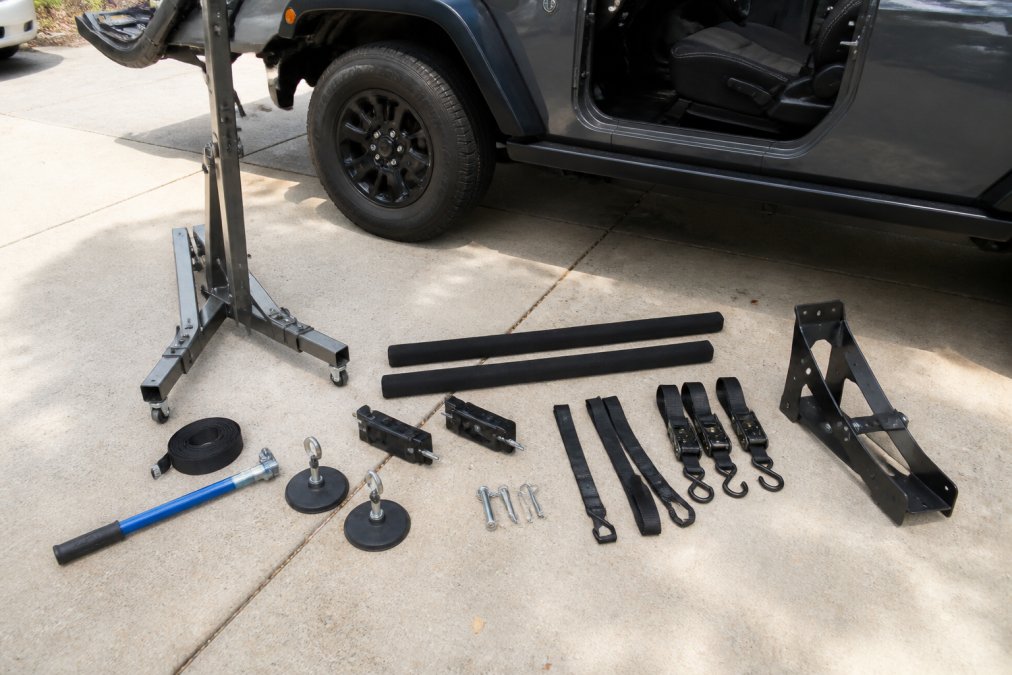
If you lack the ceiling clearance or simply do not want permanent hardware bolted to your garage, a standalone system is the answer. The TopLift Pro V2.0 is a patented, all-in-one hardtop removal and storage tool engineered specifically for Jeep Wrangler and Ford Bronco owners. It is a one-person Jeep hardtop hoist that operates without strings, pulleys, or straps, and it stores the top safely above the hood when not in use.
The system is fully adjustable for lifted vehicles and works with most rack systems. It requires no tools for operation and is backed by a limited lifetime warranty. For owners with low ceiling clearance in their garage, this design eliminates the space issues that plague overhead systems entirely.
Jeep Hardtop Removal Time: Manual vs. Pro-Grade Systems
The time difference is stark. A careful two-person manual removal typically takes 20 to 30 minutes. A ceiling hoist cuts that down once straps are attached, but you must maneuver the vehicle into the exact parking position. A standalone system like the TopLift Pro V2.0 reduces the process to under two minutes, realistic for a first-time user.
That speed matters for spontaneous trips. The difference between a 30-minute chore and a 2-minute process is the difference between going topless and staying covered. A cordless driver like the Turn Pro accessory speeds up bolt removal and keeps Torx bits organized.
LET A PRO TAKE YOUR TOP OFF™ →

Load-Testing Your Setup and Avoiding Common Mistakes
Load-testing is non-negotiable. Before trusting any lift, test it with an equivalent weight to confirm straps, cables, and anchor points hold without stretching or slipping. Check tension evenly across all lifting points and verify balanced weight distribution. A tilting hardtop can bind against the roll bar or damage freedom panels.
The most common mistakes we see are using ratchet straps that are not rated for the load, failing to secure the vehicle's parking brake during removal, and neglecting the weather stripping seal. A stuck seal is often the reason owners force the top and crack the fiberglass. Always break the seal gently before applying lift pressure.
No Garage? Portable Options and Long-Term Storage
Most guides assume you have a garage with exposed joists. If you live in an apartment, have a carport, or park on a driveway, those solutions are useless. This section addresses no-garage challenges, focusing on portable lift tools and long-term outdoor storage.
The No-Garage Removal Workflow
Without a ceiling, your only viable solo options are manual lifting or a portable, floor-based lift. Manual lifting a 120+ lb top from a driveway risks your back and the paint. A portable hoist is safer and more practical.

- Ground Clearance and Stability: A portable hoist, like the Venture Pro, uses a wide wheelbase to remain stable on uneven surfaces. When setting up on a driveway, ensure the wheels are chocked and the base is on the most level ground possible. A slight slope can cause the unit to drift as you lift.
- The Push-Pedal Mechanism: Systems like the Venture Pro use a foot pedal to drive a hydraulic or mechanical lift. This allows for precise, incremental control. You can stop at any height to check strap alignment, which is critical when working alone without a spotter.
- Wind is Your Enemy: A sudden gust can catch the large surface area of a hardtop and swing it violently. Only attempt removal on a calm day. If you feel a breeze, abort the lift and wait.
- Vehicle Positioning: You need a flat, clear area in front of the vehicle. The portable hoist sits over the hood, so you must ensure the hood is clean and free of debris that could scratch the paint when the top is lowered onto it.
Long-Term Storage: Preventing Seal Degradation and Warping
Storing a hardtop is not just about keeping it off the ground. Fiberglass, glass, and rubber seals are sensitive to their environment.
- The Compression Problem: When a hardtop sits on a vehicle, the rubber weather stripping is compressed to form a seal. If you store the top on its side or on a flat surface without proper support, the weight of the top can permanently compress the seals in new spots, causing leaks when you reinstall it. The correct method is to store it upright on a padded stand that supports the top along its structural edges, not on its flat panels.
- UV Degradation: Fiberglass gel coats are porous and will fade and chalk when exposed to direct sunlight for weeks. Even a breathable cover can trap heat. If you must store it outdoors, park it in a shaded area or build a simple PVC pipe frame and drape a high-quality, UV-resistant cover over it. Do not use a standard blue tarp, as it traps moisture and can cause mold.
- Moisture and Mold: The interior headliner is a prime spot for mold growth if moisture gets trapped. Before covering, ensure the interior is completely dry. Place a few silica gel desiccant packs inside the top to absorb any residual humidity. The cover must be breathable to allow condensation to escape.
- Hardware Corrosion: The Torx bolts and mounting brackets are prone to corrosion. Before storing, clean the threads and apply a light coat of anti-seize compound or dielectric grease. This prevents them from seizing and makes reinstallation faster.
- The 'Off-Season' Check: If you store the top for more than a month, check on it every few weeks. Look for any signs of the cover rubbing through the paint, the stand shifting, or pests (like mice) making a nest in the headliner.
Conclusion: Choose the Right DIY Hardtop Removal Tool
The right DIY Jeep hardtop removal tool balances your garage space, physical limits, and tolerance for setup time. Ceiling hoists fail owners with low clearance, lifted vehicles, or no garage. A standalone system removes those constraints.
TopLift Pros has helped over 50,000 Jeep and Bronco owners remove and store their hardtops solo in under two minutes. Our patented systems, like the TopLift Pro V2.0, offer professional-grade durability with a limited lifetime warranty. Get started with TopLift Pros and make going topless the easiest part of your next adventure.
LET A PRO TAKE YOUR TOP OFF™
Frequently Asked Questions
What size tools do I need to take the hardtop off my Jeep Wrangler?
You need a Torx T40 and T45 bit to remove the hardtop bolts on most Jeep Wranglers and Ford Broncos. A cordless driver with a magnetic bit extender makes the job faster. The Turn Pro from TopLift Pros includes both Torx bits, a rechargeable driver, and a charging station that mounts directly to your hardtop, so you never misplace the bits between removals.
Is it safe to use a DIY hoist for a Jeep hardtop?
A DIY ceiling hoist can be safe if you anchor into load-bearing ceiling joists, use rated eye bolts and straps, and test the setup before lifting. The risk comes from garage door tracks, unrated hardware, and uneven weight distribution. A standalone one-person hoist like the TopLift Pro V2.0 eliminates those variables with a patented frame that needs no ceiling mounting. Whichever route you take, verify the lifting capacity and test with the top partially raised before going full height.
How long does it take to remove a Jeep hardtop with a hoist?
With a manual process and a helper, expect 20 to 30 minutes for unbolting, lifting, and storing. A ceiling hoist cuts that to roughly 10 minutes. A standalone system like the TopLift Pro V2.0 reduces removal to under two minutes after you have unbolted the top: you roll the frame over the vehicle, lift with the pedal mechanism, and drive out. First-time users should allow a few extra minutes to get comfortable with the sequence.
What is the best tool for removing a Jeep hardtop by yourself?
The best option depends on your garage. If you have exposed ceiling joists and low clearance is not an issue, a ceiling hoist works. If you want portability or lack garage space, a standalone one-person Jeep hardtop hoist such as the LIFTnGO or Venture Pro is the safer choice. The TopLift Pro V2.0 adds integrated storage above the hood and fits lifted vehicles. All three remove the need for a second person and protect your hardtop from scratches.