


Table of Contents
- Why Removing a Jeep Hardtop Alone Is a Two-Person Job (Without the Right Gear)
- What You'll Need Before You Start
- Step-by-Step: How to Remove a Jeep Hardtop Alone Safely
- Solo Lifting Techniques Without a Hoist
- DIY Jeep Hardtop Removal: Build Your Own Hoist System
- Jeep Hardtop Hoist System Options: Manual vs. Electric
- Jeep Wrangler Hardtop Removal Time: What to Expect
- Common Mistakes That Damage Your Hardtop or Your Back
- Frequently Asked Questions
Last Updated: September 9, 2026
Why Removing a Jeep Hardtop Alone Is a Two-Person Job (Without the Right Gear)
A Jeep Wrangler hardtop weighs roughly 150 to 200 pounds depending on the model year and configuration (jeep.com). That weight is awkwardly distributed, making it a genuine hazard when you try to remove jeep hardtop alone without any mechanical assistance. The risk isn't just dropping your investment; it's the back injury that can sideline you for weeks.
Most forum advice treats solo removal as a test of strength. It shouldn't be. The real problem is use and weight distribution, not muscle. A single person lifting a top from one side creates uneven stress on the fiberglass, which can crack the shell or warp the seal over time.
Our position is simple: removing a hardtop solo is entirely safe and practical, but only when you use equipment that provides mechanical advantage. Relying on brute force is how weatherstripping gets torn and paint gets scratched.
Below, we'll walk through the complete step-by-step process, covering prep work, the exact sequence of disconnects, manual lifting techniques that protect your body, and when a hoist system becomes the smarter investment.
What You'll Need Before You Start
Before touching a single Torx bolt, gather your tools and safety equipment. Preparation prevents most of the common mistakes that damage hardtops or cause injuries.
Essential tools and supplies:
- Torx bit set (T40 and T50 are the most common sizes for Wrangler hardtop fasteners)
- Socket wrench with extensions
- Flathead screwdriver for prying trim clips
- Rubber mallet
- Painter's tape or masking tape
- Clean microfiber towels
- Marker or label stickers for tracking fasteners
- A second person OR a lifting aid (hoist, pulley, or padded strap)
Safety gear:
- Work gloves with good grip
- Closed-toe boots
- Back support belt if you have a history of lifting injuries
Step-by-Step: How to Remove a Jeep Hardtop Alone Safely
Removing a Jeep hardtop alone requires a disciplined sequence. Skip a step and you risk electrical damage, fluid leaks, or a cracked shell. Follow this order every time.
Step 1: Prep the Jeep and Gather Your Tools
Park on level ground and give yourself at least six feet of clearance on all sides. Open all four doors to access the fasteners along the door frames. Clean the area where the hardtop meets the Jeep body; dirt and grit here will scratch the paint when the top shifts during removal.
Use painter's tape to protect the paint around the door surrounds and the tailgate area. Apply tape along the edges where the hardtop will pivot or slide. This is cheap insurance against the most common cosmetic damage.
Step 2: Disconnect Electrical and Fluid Lines
The rear window defroster, wiper motor, and dome light all run through an electrical harness near the top of the roll cage. Locate the harness connector, usually tucked behind a trim panel, and unplug it carefully.
The washer fluid line runs from the rear wiper down through the hardtop. Disconnect it at the fitting and cap both ends with small plugs or tape to prevent fluid from draining into the interior. Bundle the electrical harness and washer line together with tape so they don't snag during the lift.
Step 3: Remove the Freedom Panels and Rear Glass
Removing the freedom panels first reduces the total weight you're lifting by roughly 30 to 40 pounds. Unlatch each panel using the T40 Torx bolts at the header and the latches at the rear. Store them safely away from the work area.
The rear glass and liftgate are the heaviest single components after the main shell (jeep.com). Removing the rear glass is optional but highly recommended for solo removal. The glass assembly can weigh 25 pounds or more, and it shifts the hardtop's center of gravity during the lift.
To remove the glass, disconnect the struts that hold the liftgate open, unplug the defroster and wiper harness, and unbolt the hinges. Have a padded surface ready to rest the glass on.
Step 4: Break the Seal and Lift
The hardtop sits on a rubber gasket that creates a suction-like seal against the body. Use a plastic trim tool or your fingers to work around the entire perimeter, breaking the seal before you attempt any lift. A rubber mallet tapped gently along the lower edge helps release stubborn spots.
With the seal broken, position yourself at the rear of the vehicle. Grasp the hardtop at the lower corners where the structure is strongest. Lift straight up with your legs, keeping your back neutral. The top should rise evenly; if one corner resists, stop and check for a missed bolt or connector.
Solo Lifting Techniques Without a Hoist
If you're attempting removal without a hoist, your technique determines whether you finish with an intact top or a strained back. The most common manual approach uses a padded lift strap positioned at the hardtop's balance point.
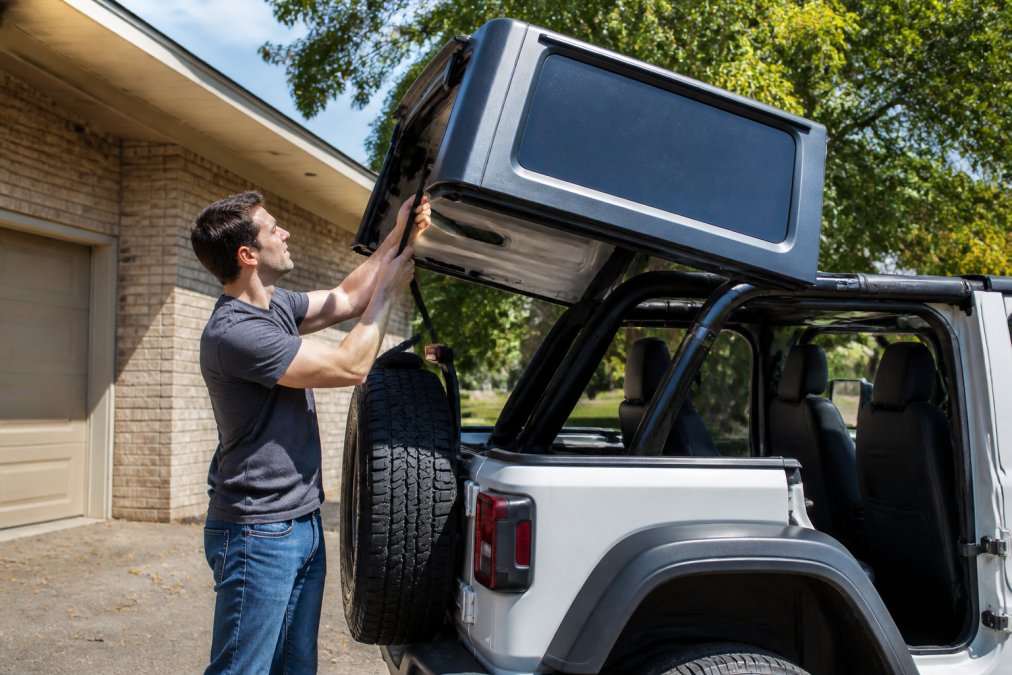
Find the hardtop's pivot point first. For most Wranglers, this sits near the B-pillar area. Loop a padded strap under the top at this point, then lift one side at a time, walking the top backward off the Jeep. This technique works but demands constant attention to weight distribution.
A safer manual method involves backing the Jeep up to a sturdy workbench or pickup truck bed. Position the workbench at the same height as the Jeep's beltline. Slide the hardtop rearward onto the bench surface, then walk it off the bench to the ground. This eliminates the need to lift the full weight overhead.
For 2-door models, the hardtop is shorter but still heavy. The same principles apply: break the seal, lift from the structural corners, and never twist the shell.
DIY Jeep Hardtop Removal: Build Your Own Hoist System
For the DIY crowd, building a ceiling-mounted hoist from a pulley system and ratchet straps is a proven approach. This setup uses mechanical advantage to do the heavy lifting.
LET A PRO TAKE YOUR TOP OFF™ →
Materials needed:
- Two heavy-duty garage pulleys
- 50 feet of rated rope or cable
- Two ratchet straps with padding
- Ceiling mounting hardware rated for at least 500 pounds
- A corner bracket to route the rope to a wall cleat
Mount the pulleys to ceiling joists positioned directly above the hardtop's balance points. Run the rope through both pulleys and down to a cleat mounted on the wall at waist height. Attach the padded ratchet straps to the hardtop at the front and rear structural points.
The mechanical advantage of a two-pulley system reduces the effective lifting force by half. Instead of lifting 180 pounds, you're pulling roughly 90 pounds of rope. This is manageable for most people, but it still requires controlled, steady pulling.
Critical safety note: Use only rated lifting hardware. Hardware store pulleys rated for 50 pounds will fail catastrophically under a hardtop's weight. Verify your ceiling joists can support the load and that all fasteners are rated for the application.
Jeep Hardtop Hoist System Options: Manual vs. Electric
Manual pulley systems are cheap but introduce their own problems. The top hangs from ceiling straps, which means it swings and can collide with your vehicle. You also need enough ceiling height to clear the Jeep entirely, which many garages lack.
Electric hoists remove the physical effort but require permanent ceiling installation and a power source. They also leave the hardtop suspended in the air, occupying your garage space indefinitely.
A different category exists: freestanding, portable lifts that don't require ceiling mounting. This is where the TopLift Pros approach differs from traditional hoists. The patented one-person system supports the hardtop on a rolling frame, eliminating the need for ceiling clearance and keeping the top at a safe working height.

| Option | Setup Required | Ceiling Clearance Needed | Physical Effort | Storage Solution |
|---|---|---|---|---|
| Manual pulley system | Moderate (mounting hardware) | Yes | Moderate | Top hangs from ceiling |
| Electric ceiling hoist | High (electrical + mounting) | Yes | Minimal | Top hangs from ceiling |
| Freestanding lift (e.g., TopLift Pros) | Low (no permanent install) | No | Minimal | Integrated rolling cart |
The freestanding option works in garages with low ceilings, a common objection we hear from 2-door Wrangler owners. It also doubles as a storage cart, so the hardtop never hangs overhead where it could be bumped or damaged.
Jeep Wrangler Hardtop Removal Time: What to Expect
A first-time removal typically takes 45 to 60 minutes when you're carefully following the steps. The bulk of that time goes to disconnecting wiring, removing freedom panels, and breaking the seal.
Once you've done it a few times, 20 to 30 minutes is realistic for a manual removal with a helper. With a dedicated lifting system, that time drops dramatically. The TopLift Pros system is designed to complete the entire removal in under two minutes once the electrical and fluid lines are disconnected.
The time difference matters more than most owners expect. If you're the type who removes the top every weekend for off-roading, spending an hour each time adds up to a full day of lost trail time every couple of months. A system that makes the transition quick changes how often you actually use your Jeep in open-air mode.
Common Mistakes That Damage Your Hardtop or Your Back
The most frequent errors we see come from owners rushing the process or improvising without the right equipment.
Forgetting to disconnect the washer fluid line. This is the #1 cause of interior flooding. The line runs inside the hardtop and will drain fluid directly into the cargo area if not capped.
Lifting from the wrong points. Grabbing the hardtop by the window edges or the roof panels puts stress on the fiberglass where it's thinnest. Always lift from the lower structural corners near the door surrounds.
Skipping the seal break. Forcing the top upward while the gasket is still stuck can crack the fiberglass at the mounting points. Work the seal loose completely before lifting.
Storing the hardtop improperly. Leaving it flat on the ground warps the shell over time. The gasket loses its shape, and the top no longer seals properly against the body. Store it upright on a padded frame or a purpose-built cart.
Ergonomic injury prevention is the angle most guides ignore (the CDC). Repeated hardtop removal without mechanical assistance strains the lumbar spine and shoulder rotator cuffs.
Removing a Jeep Wrangler hardtop alone is achievable, but the method you choose determines whether it's a five-minute task or a trip to the chiropractor. Manual techniques work in a pinch but carry real risks to both your back and your hardtop's structural integrity. For owners who remove their tops regularly, a dedicated lifting system transforms the experience from a chore into a quick transition. TopLift Pros offers patented, portable solutions trusted by over 50,000 Jeep Wrangler and Ford Bronco owners, designed to remove and store your hardtop solo in under two minutes without requiring ceiling clearance. Whether you choose the versatile TopLift Pro V2.0 or the portable LIFTnGO system, you're investing in equipment that protects your vehicle and your body. Let a pro take your top off, and get back on the trail faster.
Frequently Asked Questions
Can you remove a Jeep hardtop by yourself?
Yes, you can remove a Jeep hardtop alone, but you need the right equipment. A factory hardtop weighs 120-150 pounds, which makes manual removal risky for both you and the top. A pulley system, a portable lift like the TopLift Pro, or a DIY hoist gives you the mechanical advantage to lift safely. Without a hoist, you risk back injury, dropping the top, or scratching the paint. A hoist system also lets you store the top overhead, freeing up garage floor space.
What tools are needed to remove a Jeep hardtop?
You will need a Torx bit set and socket wrench to remove the bolts securing the hardtop to the roll cage, a flathead screwdriver to disconnect the electrical harness and washer fluid line, and a socket for the rear window latches. You also need a padded work surface, painter's tape to protect the paint, and a lifting system. A hoist with straps rated for the hardtop's weight is essential for solo removal.
How long does it take to remove a Jeep hardtop?
With a manual process and a friend helping, expect to spend 30 to 45 minutes on your first attempt. Once you learn the steps, the process takes about 15 to 20 minutes with two people. Using a purpose-built electric hoist system, like the TopLift Pro, reduces that time dramatically. Owners report going from a fully sealed hardtop to open air in under two minutes after just a few practice runs.
How can I make a DIY hardtop removal system?
A basic DIY hoist uses heavy-duty pulleys, rope or cable, and ceiling-mounted eye bolts anchored into studs. Attach straps to the hardtop, route the rope through the pulleys, and use a hand crank or winch to lift. This system works but requires careful weight distribution and alignment. A purpose-built portable lift like the Venture Pro removes the guesswork and setup time.