


Table of Contents
- Quick Comparison: Best Hardtop Hoists for Garage Storage
- How We Evaluated the Best Hardtop Hoist for Garage Use
- TopLift Pro V2.0: The One-Person Hardtop Removal Tool Built for Solo Owners
- Venture Pro and LIFTnGO: Portable Hardtop Hoist Picks Under $700
- Electric vs Manual Hardtop Lift: Which One Fits Your Garage?
- Hardtop Hoist Installation Guide: Ceiling Height, Joists, and Electrical Needs
- Which Hardtop Hoist Should You Pick?
- Frequently Asked Questions
Last Updated: September 14, 2026
Quick Comparison: Best Hardtop Hoists for Garage Storage
The best hardtop hoist for garage use depends on one thing above all: whether you have the ceiling height to lift a top clear of your vehicle. Get that wrong and even a well-built system sits in a box. This guide from TopLift Pros breaks down what matters, from weight capacity and mounting to electrical needs.
Here's the short version before the details.
System |
Price |
Type |
Best For |
|---|---|---|---|
$749.99-$849.99 |
Portable one-person tool |
Most Jeep and Bronco owners |
|
Venture Pro |
$649.99-$699.00 |
Portable, travel-ready |
Owners who remove tops away from home |
LIFTnGO |
$699.99 |
Portable, compact |
Tight garages and small footprints |
Ceiling-mounted hoist |
Varies |
Manual or motorized |
High ceilings, permanent setups |
A hardtop hoist is a lifting system that raises a removable roof off a vehicle and holds it in storage, either overhead or on a standalone frame. The three main categories are overhead manual hoists, overhead motorized hoists, and portable carts, a split confirmed by JLWranglerForums discussion of hardtop removal devices.

How We Evaluated the Best Hardtop Hoist for Garage Use
We scored every option against five criteria: ceiling height required, weight capacity, one-person operation, storage footprint, and durability. Ceiling height eliminated more systems than any other factor.
A standard electric hardtop lift carries up to 220 lb, while common garage power hoists handle 440 lb, according to Bestop hardtop storage specifications. Multi-purpose four-point hoists typically list 200 lb, per Quadratec hoist product data. Capacity matters less than fit, though. A 440 lb hoist is useless if your ceiling can't clear the roofline.
TopLift Pro V2.0: The One-Person Hardtop Removal Tool Built for Solo Owners
TopLift Pro V2.0 is our top pick for most owners because it removes the ceiling-height problem entirely. It's a patented, standalone one-person hardtop removal tool, not an overhead system, so it works where hoists won't fit.
The process takes under two minutes with no tools required, and when the top is off, the system stores it above the hood to preserve floor space. It's adjustable for lifted vehicles, works with or without a trailer hitch, and carries a limited lifetime warranty. More than 50,000 owners have used the platform, per TopLift Pros customer base.
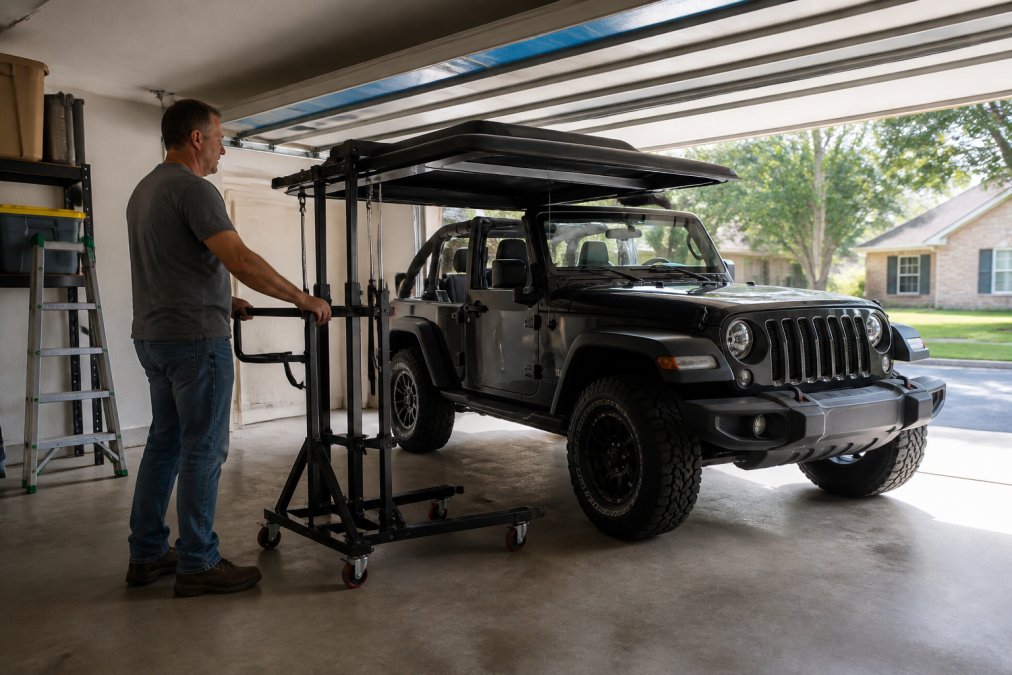
The honest limitation: it's a premium purchase at $749.99-$849.99 and takes up floor space when deployed. If you have a high ceiling and want the top permanently out of the way, a ceiling mount wins on footprint.
Venture Pro and LIFTnGO: Portable Hardtop Hoist Picks Under $700
Portability is the whole point of these two. The Venture Pro ($649.99-$699.00) comes semi-assembled and folds for travel, using a 5-to-1 push-pedal lifting system. The LIFTnGO ($699.99) fits 2- and 4-door Jeeps and 4-door Broncos, assembles in minutes, and stores in small spaces.

Both run on solo operation, use high-grade alloy steel, and carry a limited lifetime warranty. The trade-off versus the TopLift Pro V2.0 is the lifting mechanism: a pedal system asks more physical effort than the flagship's design.
Electric vs Manual Hardtop Lift: Which One Fits Your Garage?
Manual hoists use a pulley and ratchet system with a hand crank; motorized units use an electric winch with a remote. Motorized lifts cut effort but add electrical requirements and a higher failure point; manual systems cost less and never trip a breaker. Here is what actually separates them in a garage.
Lifting Effort and Cycle Time
A manual hand-crank hoist with a 4-to-1 or 5-to-1 pulley ratio turns a 100 lb hardtop into roughly 20 to 25 lb of effort at the crank, manageable but slow, with a few minutes of steady cranking to raise and secure a top. A motorized winch does the same lift in well under a minute at the push of a button, which matters most when you remove and reinstall the top frequently or alone.
Capacity and Mechanism
- Manual: Rope or cable over pulleys, a ratchet or brake to hold position, and a hand crank. Fewer moving parts, no power source, and a mechanical brake that holds the load if you let go.
- Motorized: An electric winch with a remote, a limit or stop mechanism, and a power feed. Faster and easier, but the winch, switch, and wiring can all fail.
A standard electric hardtop lift carries up to 220 lb, while common garage power hoists handle 440 lb, according to Bestop hardtop storage specifications. Multi-purpose four-point hoists typically list 200 lb, per Quadratec hoist product data. Match the rating to your top with margin to spare, a steel or aftermarket top is heavier than a stock fiberglass one.
Electrical and Reliability Trade-offs
Motorized units need a nearby outlet, safe cable routing, and a circuit that can carry the draw (see the installation section above). Manual systems need none of that and never trip a breaker, a real advantage in an older garage with one overloaded circuit. The flip side: a manual hoist asks for physical effort every time, while a motorized one asks for nothing until the day it does not respond.
Safety Features to Look For Either Way
- Anti-drop or brake mechanism. A manual ratchet brake or a motorized self-locking winch is what keeps the top from coming down on its own. Do not buy a system without one.
- Secondary retention. A safety strap or chain as a backup to the primary lift is cheap insurance on any overhead system.
- Load rating margin. Buy above your top's weight, not at it.
Which One Fits Your Garage
For most owners, the deciding factor isn't power, it's whether the top needs to come off solo and fast. A portable one-person system sidesteps the electric-versus-manual debate entirely, no ceiling, no wiring, no cranking. For an overhead setup, choose motorized when you have a dedicated outlet and remove the top often, and manual when your circuit is limited, your budget is tight, or you value fewer failure points over speed.
Hardtop Hoist Installation Guide: Ceiling Height, Joists, and Electrical Needs
Proper installation starts with three checks: vertical clearance, ceiling joist location, and power access for motorized units. Skip any one and the system either won't fit or won't be safe. Here is the math and the hardware.
Ceiling Height: The 8-Foot vs. 10-Foot Rule
Add up four numbers before you buy: your vehicle's roof height, the thickness of the hardtop, the vertical travel the hoist needs to clear the roofline, and the headroom you want when you park underneath. A lifted Wrangler on 35s sits around 6 ft 6 in to the top of the hardtop, a stock Bronco four-door lands near 6 ft 1 in, and a stock Wrangler Unlimited is close to 6 ft. A hoist needs roughly 12 to 18 in of lift travel above the seated top to clear the windshield frame and roll bar, plus 6 to 12 in of buffer so you are not ducking under a suspended roof every morning. Accounting for these dimensions ensures your garage setup remains functional even when you transition to larger tires or modified suspension configurations that complicate standard off-road vehicle fitment.
- 8-foot ceiling (96 in): Workable for a stock-height vehicle if you mount the hoist tight to the ceiling and accept a low buffer. Lifted rigs and tall aftermarket tops usually will not clear. This is the ceiling most portable systems were designed around.
- 9-foot ceiling (108 in): The comfortable zone for stock and mildly lifted vehicles. You get real walking clearance under a suspended top.
- 10-foot ceiling and above (120 in+): Room for lifted vehicles, dual-hoist setups, and storing the top high enough that it never blocks the garage door track.
Measure from the finished floor to the lowest obstruction, usually a garage door opener rail, a light fixture, or a storage rack, not the bare ceiling. The obstruction, not the slab, is what limits you.
Structural Integrity: Can Your Rafters Carry the Load?
An overhead hoist transfers the full weight of the top, plus the dynamic load of lifting and any bounce while it hangs, into your ceiling structure. A 100 lb hardtop hanging from a single point is not the same as 100 lb spread across four anchor points tied into two or more joists.
- Find the joists, not the drywall. Use a stud finder or tap test to locate ceiling joists, which typically run 16 in or 24 in on center. Never anchor a hoist into drywall, plaster, or a furring strip.
- Spread the load. A four-point hoist tied into two or more joists distributes stress far better than a single central anchor. Use any spreader bar or mounting plate your kit includes.
- Match the fastener to the load. Lag bolts sized for the joist and the hoist's rated capacity are the baseline; through-bolting with a backing plate is stronger where access allows. Follow the manufacturer's fastener spec.
- When in doubt, add a header. If joists run parallel to the vehicle or the span feels springy, bridge two joists with dimensional lumber and anchor the hoist to that.
If you are unsure whether your ceiling structure can take the load, have a licensed contractor or structural professional look at it before you drill. This is not a place to guess.
Electrical Requirements for Motorized Units
Motorized hoists draw real current, and a garage circuit already feeding a freezer, a shop light, and a battery tender is not the place to add a winch on an extension cord.
- Dedicated outlet. Most motorized hoists are happiest on a dedicated 15-amp or 20-amp circuit near the mounting point. Check the nameplate for its amperage draw and confirm the circuit can carry it alongside anything else on that breaker.
- Cord routing. Route the power cord overhead and out of any walking path, and never let it cross the garage door track or the vehicle's travel path. A cord that can be snagged while the top is in the air is a hazard.
- Extension cords. If you must use one, match the cord's gauge and amperage rating to the hoist and keep the run short. A long, undersized cord causes voltage drop, heat, and premature motor failure.
- GFCI protection. Garages are damp; a GFCI-protected outlet is the standard expectation for a motorized lift here.
Long-Term Storage: Protecting the Top While It Hangs
A hardtop may hang for months, and that is where careless storage does its damage. Weatherstripping and seals dry out, crack, and lose shape when a top sits under load or in direct sun.
- Support it evenly. Use the hoist's straps or cradle so the top is not resting on one corner or pinching a seal.
- Keep it out of direct sun. UV degrades rubber seals and can warp a top over a full season. A shaded bay or a breathable cover helps.
- Treat the seals before storage. A silicone-based conditioner on the weatherstripping keeps it pliable so it reseals properly when the top goes back on.
- Check the straps. Inspect webbing and hardware every few months; a strap that has been under tension for a year is worth a look before you trust it with the top again.
Which Hardtop Hoist Should You Pick?
Pick a portable one-person system if your garage has low ceilings, limited floor space, or you remove the top solo. Pick a ceiling hoist only if you have the vertical clearance and a permanent mounting point.
For most Jeep Wrangler and Ford Bronco owners, the TopLift Pro V2.0 is the best hardtop hoist for garage use because it removes every installation constraint at once. It's the only lift in the market that have the electric portability, removes the top in under two minutes, and stores it above the hood instead of the ceiling.
If budget is tighter, the Venture Pro and LIFTnGO deliver the same one-person operation for less.

Frequently Asked Questions
Can I remove a hardtop by myself?
Yes. A one-person hardtop removal tool like the TopLift Pro V2.0 lets you lift and store a Jeep Wrangler or Ford Bronco hardtop without a second set of hands. The patented design supports the top on a padded platform while you drive out from under it. TopLift Pros reports over 50,000 customers use this approach, and owners say the full removal takes about two minutes.
What is the best way to store a hardtop in a garage?
The best hardtop hoist for garage storage keeps the top off the floor and out of your parking space. Ceiling-mount hoists lift it overhead, but they need enough vertical clearance and solid joists. Portable systems like the TopLift Pro V2.0 or Venture Pro store the top above the hood of the vehicle, so you keep your garage footprint and avoid drilling into the ceiling.
Are manual or electric hardtop lifts better?
It depends on your garage. An electric vs manual hardtop lift decision usually comes down to ceiling height and wiring. Motorized ceiling hoists handle around 220 lb and need a power source near the mounting point. Manual pulley and pedal systems, like the 5-to-1 push-pedal on the Venture Pro, need no electricity and work in garages with lower ceilings.
Do I need a professional to install a hardtop hoist?
Not for portable systems. The TopLift Pro V2.0 and Venture Pro assemble in minutes with basic hand tools and no ceiling drilling. A hardtop hoist installation guide for ceiling-mounted units is different: those require locating joists, checking structural support, and confirming the joist can carry the load. If you are unsure about your garage framing, hire a contractor for that step.
How much space do I need in my garage for a hardtop hoist?
A ceiling hoist needs enough vertical clearance to lift the top clear of the vehicle, often 7 feet or more depending on your build. Portable carts and stands need floor space only while in use. The TopLift Pro V2.0 stores the hardtop above the hood, so it frees the parking bay once the top is off. Measure your ceiling height and door clearance before buying.
Low ceilings and tight garages rule out most overhead hoists, and that's exactly the problem TopLift Pros was built to solve. The TopLift Pro V2.0 gives you patented one-person operation, removal in under two minutes, and storage above the hood instead of the ceiling, all backed by a limited lifetime warranty and a U.S.-based support team. Let a pro take your top off. Get started with TopLift Pros and get back on the trail faster.