


Table of Contents
- The Real Cost of Removing a 150-Pound Hardtop Alone
- Jeep Hardtop Removal Time: What Solo Owners Actually Save
- Best Hardtop Hoist for Garage Space and Ceiling Limits
- Jeep Wrangler Hardtop Removal Safety: Straps, Bolts, and Stability
- TopLift Pro V2.0 vs LIFTnGO vs Venture Pro: Which Solo Hoist Fits Your Setup
- What a Hardtop Hoist Costs Over Time (and What Breaks First)
- Garage Structural Requirements and Insurance Questions Nobody Asks
- Frequently Asked Questions
Last Updated: September 20, 2026
The Real Cost of Removing a 150-Pound Hardtop Alone
A standard Jeep Wrangler hardtop, freedom panels included, weighs roughly 150 pounds, according to Wrangler Forum hardtop hoist discussion. That single number explains why the question "is solo hardtop hoist worth it" keeps showing up in every Jeep and Bronco community. TopLift Pros has watched this debate play out across more than 50,000 owners, and the answer comes down to how you value your time, your back, and your paint.
A solo hardtop hoist is worth it if you remove your top more than a few times a year. The math changes for everyone else. Three lifts a season with a friend costs nothing. Twelve lifts a season solo, with the risk of a dropped fiberglass top, is a different calculation entirely.
Here is what most buyers get wrong: they compare the sticker price of a hoist to zero. The real comparison is the hoist against the cost of help you do not have, the time you burn waiting for it, and the repair bill if the top slips.
Jeep Hardtop Removal Time: What Solo Owners Actually Save
Manual removal with two people takes 10 to 15 minutes once you factor in unbolting the six fasteners and finding a place to set the top down. Solo, that same job stretches longer because you are balancing weight distribution and clearance at the same time.
TopLift Pros' system completes removal and storage in under two minutes. One owner on r/Wrangler clocked a Hoist-a-Cart setup at under 30 seconds after the bolts were out. That gap, 15 minutes versus 2, is the whole argument for a mechanical advantage system.
Over a season of weekend wheeling, that adds up fast:
| Task | Manual (2 people) | Solo hoist |
|---|---|---|
| Unbolt fasteners | 3-5 min | 3-5 min |
| Lift and move top | 5-8 min | Under 2 min |
| Storage placement | 2-3 min | Included |
| Help required | Yes | No |
The time-saving is real, but it is not the main benefit. The main benefit is not needing to schedule your top removal around someone else's calendar.
Best Hardtop Hoist for Garage Space and Ceiling Limits
Ceiling height is the dealbreaker most buyers discover too late. A ceiling-mounted pulley system needs enough vertical clearance for the top to rise fully above the vehicle, and plenty of garages do not have it. Quadratec's hardtop hoist comparison notes that overhead hoists suit owners with sufficient garage or carport ceiling height, while floor-based systems work in tighter spaces.
That is the split that matters: ceiling mount versus floor cart.
Floor-standing systems like the TopLift Pro V2.0 ($849.99) sidestep ceiling limits entirely. The top stores above the hood, so your garage footprint stays clear. The LIFTnGO ($699.99) takes the same approach in a more compact, travel-friendly frame that fits 2- and 4-door Jeeps and 4-door Broncos.
TopLift Pro V2.0 - Hardtop Removal & →


Jeep Wrangler Hardtop Removal Safety: Straps, Bolts, and Stability
Safety is where cheap systems fail. A 150-pound fiberglass top suspended on thin straps or a single pulley can swing, scratch paint, or drop. Jeep Wrangler hardtop removal safety comes down to four things: fasteners, straps, stability, and the inspection habits that keep all three working.
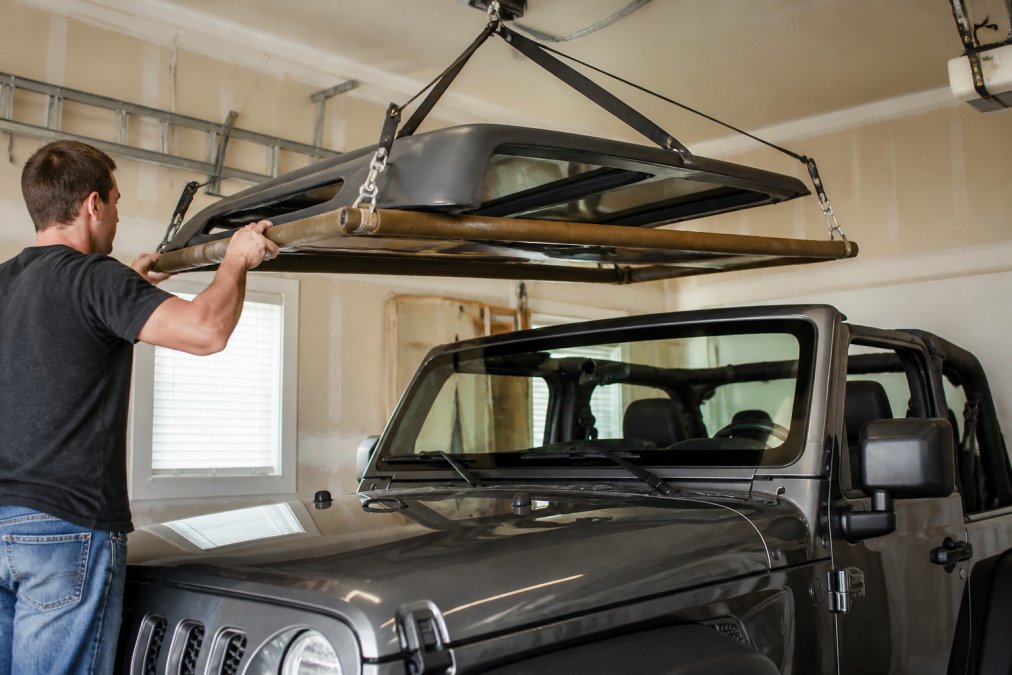
Bolts first. Loosen all six fasteners before lifting anything, and keep them in a labeled bag so they do not roll under the vehicle. A common mistake is lifting one corner before the rest are free, which stresses the fiberglass and can crack the mounting points. On a Wrangler JL, the two rear bolts sit behind the rear seat and are the ones owners most often forget; on a JK, the front two are the ones that strip if you cross-thread them going back in.
- Anchor bolts and lag screws for any sign of backing out (a paint mark across the bolt head and the joist makes a turn obvious at a glance)
- Strap webbing for glazing, stiffness, or frayed edges, UV and cold both degrade nylon faster than most owners expect
- Pulley sheaves for flat spots or a groove worn into the side plate
- Cable for kinks, bird-caging, or broken strands (a single broken strand means replace the cable, not just watch it)
- The hardtop's own mounting tabs for hairline cracks around the bolt holes
One more habit worth building: never stand under a suspended top, and never let anyone else stand under it either. The failure mode is fast and the top is heavy enough to cause real injury, not just a paint chip. Treat the space under a raised top the same way you would treat the space under a car on a jack, fine for a second, never for a minute.
TopLift Pro V2.0 vs LIFTnGO vs Venture Pro: Which Solo Hoist Fits Your Setup
Three TopLift Pros systems cover nearly every solo owner, and the differences come down to portability and lifting mechanism rather than quality. All three carry a limited lifetime warranty and are built for one-person operation.
| System | Price | Best For | Key Difference |
|---|---|---|---|
| TopLift Pro V2.0 | $849.99 | Fixed garage setups | Patented all-in-one, stores top above hood |
| LIFTnGO | $699.99 | Tight spaces, travel | Compact, fits 2- and 4-door Jeeps, 4-door Broncos |
| Venture Pro | $699.00 | Off-site removal | Portable, 5-to-1 push-pedal lifting system |
What a Hardtop Hoist Costs Over Time (and What Breaks First)
- Completeness. Original hardware, the manual, and any included padding or straps matter more than most sellers expect. A hoist missing its anchor kit is a project, not a product.
- Cosmetic condition. Powder coat chips and rust spots read as neglect even when the mechanism is fine. A wipe-down and a touch-up pen before listing is worth real money.
If you are comparing two systems at similar prices, ask what the wear parts are and what they cost to replace. A $700 hoist with a $60 strap kit every two years is not the same purchase as a $850 hoist with no consumables. Over five seasons, the cheaper sticker can easily be the more expensive tool.
Garage Structural Requirements and Insurance Questions Nobody Asks
Ceiling-mounted hoists put load on your garage ceiling joists, and that is a structural question, not a product question. Most residential garage ceilings were never engineered for a repeated 150-pound dynamic load hanging from a single point. If you go the ceiling route, have someone confirm your joists can take it.
Frequently Asked Questions
How long does it take to remove a hardtop with a solo hoist?
TopLift Pros reports that hardtop removal and storage can be completed in under two minutes with their patented system. One Reddit user with a Hoist-a-Cart system reported removal and storage in less than 30 seconds after the bolts were removed. First-time users should expect closer to the two-minute mark while learning the process. The time savings add up quickly if you remove your top weekly during warmer months.
Is it possible to remove a hardtop by yourself without a hoist?
It is physically possible but risky. A standard Jeep hardtop weighs approximately 150 pounds, and lifting that weight overhead without mechanical assistance puts your back and the fiberglass top at risk. Most solo owners who try manual removal either recruit a friend or end up with scratches and dents. A hoist or cart system removes the lifting burden entirely and keeps the top stable during the transition.
What safety features should I look for in a hardtop hoist?
Look for a system with a stable base or secure ceiling mount, padded contact points to protect the fiberglass top, and a locking mechanism that holds the top in place during storage. TopLift Pros systems use a patented standalone design with no straps or pulleys, which eliminates the swinging and shifting that causes most damage. Check that the hoist is rated for at least 150 pounds and that the legs adjust for lifted vehicles.
Do I need a professional-grade hoist for occasional hardtop removal?
If you remove your hardtop more than twice a year, a professional-grade system pays for itself in avoided damage and saved time. DIY hoist setups can be built for under $20, but forum users report needing constant fine-tuning and worrying about ceiling joist strength. A system like the TopLift Pro V2.0 at $849.99 or the LIFTnGO at $699.99 includes a limited lifetime warranty and protects your hardtop's resale value.
Will a solo hoist work with a lifted Jeep or one with a trailer hitch?
Yes, if you choose an adjustable model. The TopLift Pro V2.0 features adjustable legs that extend to meet lifted vehicles and works with or without trailer hitches. The LIFTnGO and Venture Pro are also compatible with lifted vehicles and trailer hitches. Always confirm the specific model fits your Jeep Wrangler or Ford Bronco configuration before ordering, and contact the manufacturer if you are unsure.