


Table of Contents
- Hardtop Hoist vs Manual Removal: The Quick Comparison
- How Manual Hardtop Removal Actually Works (Step by Step)
- Hardtop Removal Time Comparison: Minutes vs an Afternoon
- One Person Hardtop Removal: Is It Really Safe?
- Garage Ceiling Height, Clearance, and Storage Space
- Choosing the Best Jeep Hardtop Hoist for Your Setup
- What Most Comparisons Miss: Maintenance, Insurance, and Resale
- Conclusion
- Frequently Asked Questions
Last Updated: September 23, 2026
Hardtop Hoist vs Manual Removal: The Quick Comparison
A factory hardtop weighs between 120 and 150 pounds, according to TopLift Pros weight specifications for standard Jeep Wrangler hardtops. That single number explains why the jeep hardtop hoist vs manual removal debate keeps coming up in every Wrangler and Bronco forum. At TopLift Pros, we've watched more than 50,000 owners wrestle with this exact decision, and the answer usually comes down to three things: your garage, your back, and how often you actually go topless.
A hardtop hoist is a mechanical lifting system, an overhead pulley rig or a freestanding portable lift, that raises the roof off your vehicle without you carrying its weight. Manual removal means you and a helper lift the top off by hand and set it on the ground or a storage rack.
The time gap is not close.
How Manual Hardtop Removal Actually Works (Step by Step)
Manual removal is the cheapest method most owners start with, and the most likely to end with a chipped paint edge or torn weather strip.
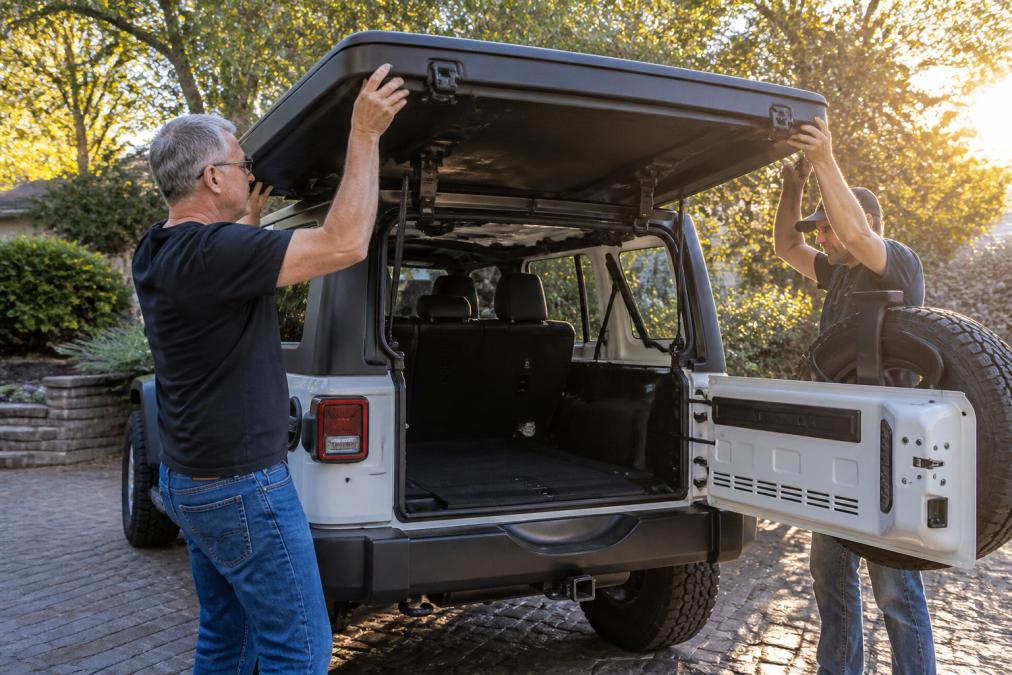
What You'll Need Before You Start
- A second person, no exceptions at this weight
- A flat, clean surface to set the top down
- A blanket or foam pads if you're resting it on concrete
- A T-40 or similar Torx driver for the mounting bolts
- Gloves, because the rear edge bites
Common Mistakes and Damage Risks
The most common mistake is lifting unevenly: one side comes up first, the top twists, and the weather stripping along the door opening takes the stress. The second is setting the top on concrete, which scuffs the rear lip and defroster wiring cover.
Hardtop Removal Time Comparison: Minutes vs an Afternoon
Manual removal takes 20 to 40 minutes with two people who know what they're doing, longer the first time. A hoist or portable lift cuts that to under two minutes for one person.
| Method | People Needed | Typical Time | Damage Risk | Storage |
|---|---|---|---|---|
| Manual lift by hand | 2 | 20-40 min | High | Floor or rack |
| Overhead pulley hoist | 1 | 5-10 min | Moderate | Ceiling-mounted |
| Portable lift system | 1 | Under 2 min | Low | Above the hood |
One Person Hardtop Removal: Is It Really Safe?
This is where a purpose-built system changes the math. The TopLift Pro V2.0 is a patented standalone tool that lets one person remove and store a hardtop without a second set of hands, on both Wrangler and Bronco. Adjustable legs extend to clear lifted vehicles and trailer hitches.

Garage Ceiling Height, Clearance, and Storage Space
Overhead hoists need ceiling height most garages don't have. A pulley system must raise the top clear of the roll bar and hold it there, typically 9 feet or more. Standard garages run 7 to 8 feet, and a low-clearance door track eats into that further.
Vaulted and Cathedral Ceilings
A vaulted ceiling has no flat plane to bolt a hoist into. Joists run at an angle, the peak is often 12 feet or more, and the low side may be under 8 feet. Mounting at the peak gives lift height but a terrible pull angle, the cable runs diagonally, the top swings, and the load isn't straight down on the anchor.
Finished and Drywalled Ceilings
A finished ceiling hides the joists, so you can't safely place an anchor without a stud finder and luck or cutting an inspection hole. Drilling through means patching drywall, matching texture, and repainting if you remove the hoist, a real cost most buyers don't price in. Freestanding systems leave the ceiling untouched, which matters if you rent or plan to sell.
Low-Clearance and Torsion-Spring Garages
The garage door track and torsion spring assembly occupy the top 12 to 18 inches of ceiling near the door, so a hoist mounted there fouls the door as it travels. You must mount deeper into the garage, shortening the usable bay and possibly putting the lifted top over a second vehicle's hood. Measure the clear zone behind the door track, that's the space a hoist can actually use.
Post-Tension and Engineered Floor Systems
Some newer homes use post-tension slabs or engineered floor trusses above the garage. Post-tension slabs are a floor issue, but engineered trusses are often rated for storage loads far lower than a 130-pound hardtop plus hoist hardware and dynamic load. A truss rated for drywall and insulation may not be rated for a point load. If unsure, a structural engineer is cheaper than a collapsed ceiling.
TopLift Pro V2.0 - Hardtop Removal & →
The Freestanding Alternative
Freestanding systems sidestep every one of these problems. The TopLift Pro V2.0 stores your hardtop above the hood rather than bolting to the ceiling, so vertical space and ceiling type stop being the deciding factor. For 2-door Wrangler owners with tight garages, that's the difference between a system that works and one that sits in the box.
Choosing the Best Jeep Hardtop Hoist for Your Setup
The best jeep hardtop hoist for most owners is a freestanding, one-person system that doesn't depend on ceiling height or a second person. Overhead pulley rigs still work if you have clearance and want to spend less upfront.
| System | Price | Best For | Key Trade-off |
|---|---|---|---|
| LIFTnGO | $699.99 | Travel and small spaces | Portable, folds down |
| Venture Pro | $699.00 | On-the-road removal | 5-to-1 push-pedal system |
| Gladiator Pro | $699.00 | Jeep Gladiator JT owners | Purpose-built for the JT |
| TopLift Pro V2.0 | $849.99 | Most Wrangler and Bronco owners | Premium price, lifetime warranty |
What Most Comparisons Miss: Maintenance, Insurance, and Resale
Three things get ignored in nearly every hardtop hoist comparison: what happens to the mechanism over five years, whether your insurer cares, and what the equipment is worth at resale. Each changes the real cost of ownership, and none show up on a product page.


Long-Term Maintenance of Lift Mechanisms
Freestanding systems have fewer wear points because there's no ceiling-mounted cable path. The load path is short, pulleys are fewer, and nothing is bolted to the structure to work loose. TopLift Pros backs its tools with a limited lifetime warranty, unusual in this category.
Insurance and Liability Implications
Insurance and liability rarely come up until something goes wrong. If a ceiling-mounted hoist fails and damages your Jeep or a vehicle beside it, that's typically a homeowner's claim, and the outcome depends on how the adjuster reads your policy.
Resale Value of Removal Equipment
Resale value cuts both ways. A dropped hardtop or torn weather stripping costs you at trade-in, a cracked rear glass panel or full weather strip replacement runs well past the price gap between manual lifting and a proper system.
Conclusion
The jeep hardtop hoist vs manual removal decision gets easier once you compare total cost instead of sticker prices. Manual removal is free until it isn't, and a single dropped top wipes out the savings.
Frequently Asked Questions
Can one person remove a Jeep hardtop without a hoist?
Physically, yes, but it is risky. Factory hardtops weigh 120 to 150 pounds, which is awkward to lift alone because of the shape and balance point. Most owners who try it solo end up dragging the top across the tub or dropping it. A hardtop hoist or a purpose-built lift tool lets one person handle the same top without the strain, which is why one person hardtop removal systems have become so popular.
How much time does a hardtop hoist save compared to manual removal?
A hardtop removal time comparison favors the hoist by a wide margin. Specialized hoist systems complete removal and storage in under two minutes. Manual removal usually takes 15 to 30 minutes with a helper, plus extra time to find a safe place to set the top down. Over a full season of open-air driving, that gap adds up to hours.
Do I need a garage to use a hardtop hoist system?
Not with a portable system. Ceiling-mounted hoists require a garage with enough overhead clearance and solid joists to anchor into, which rules out carports, apartment garages, and low-clearance spaces. Standalone tools like the TopLift Pro V2.0 store the hardtop above the hood instead, so they work in a driveway or any flat surface without drilling into your ceiling.
What are the main risks of manual hardtop removal?
The biggest risks are dropping the top, scratching the paint, and damaging the weather stripping or mounting hardware. There is also the physical risk to the person lifting, since 120 to 150 pounds held at an awkward angle is a common source of back strain.
What should I look for in the best Jeep hardtop hoist?
Look for one-person operation, a weight capacity that covers your top, and a footprint that fits your storage space. The best Jeep hardtop hoist for most owners also avoids ceiling mounting, since that limits where you can use it. TopLift Pros systems start at $699.00 and are backed by a limited lifetime warranty, with more than 50,000 owners using them.