


Table of Contents
- Why Proper Hardtop Storage Matters
- Tools and Materials You'll Need
- Step-by-Step: How to Safely Store a Jeep Hardtop in Your Garage
- Jeep Hardtop Storage Hoist: What to Look For
- Preventing Hardtop Warping During Storage
- DIY Jeep Hardtop Storage Cart: Build vs. Buy
- Common Mistakes to Avoid When Storing Your Hardtop
- Frequently Asked Questions
Last Updated: September 13, 2026
Why Proper Hardtop Storage Matters
Learning to safely store a Jeep hardtop in your garage protects one of the most expensive components on your vehicle. A Wrangler or Bronco hardtop costs well over a thousand dollars to replace, and improper storage is the fastest way to warp the panels, crack the rear window frame, or scuff the painted finish beyond repair (quadratec.com).
Garage space is usually the second problem. Most owners discover that a hardtop takes up serious square footage once it's off the vehicle, and a top left leaning against a wall or resting on the floor is an accident waiting to happen. A hardtop that tips over can crack at the corners or damage whatever it lands on.

The good news: with the right method, one person can handle the whole job. The TopLift Pros team has spent years refining solo removal and storage systems, and the approach below works whether you're storing your top for a weekend or a full season. Below, we'll walk through the tools, the four-step process, and the mistakes that ruin hardtops every year.
Tools and Materials You'll Need
Before you start, gather everything so you're not hunting for tools mid-lift. A hardtop weighs roughly 80 to 100 pounds depending on the model, and you don't want to be holding it while you search for a strap (quadratec.com).
What you'll need:
- A hardtop hoist or storage cart rated for your top's weight
- Furniture dolly or moving blanket for floor-based methods
- Soft tie-down straps or padded slings (never bare chains or hooks)
- Painter's tape or felt pads for contact points
- A clean, level area at least 8 feet long
- Work gloves and a second person for the first attempt
Step-by-Step: How to Safely Store a Jeep Hardtop in Your Garage
The safest method lifts the hardtop vertically and stores it on a dedicated stand, keeping it off the floor and away from traffic.
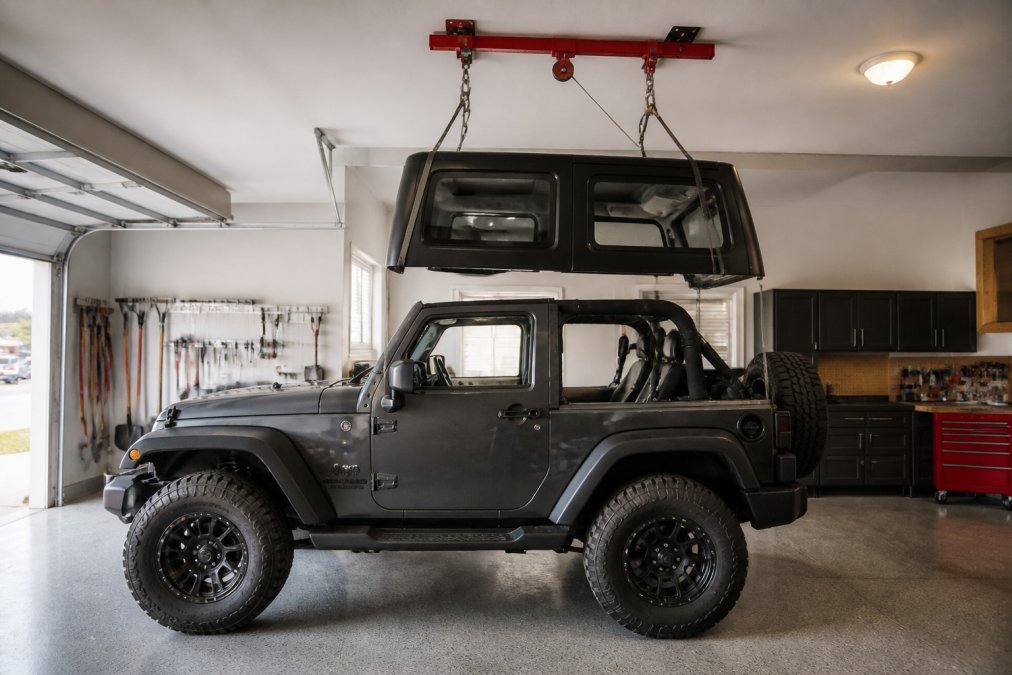
Step 1: Prepare Your Garage and Hardtop
Clear a space roughly the size of the vehicle plus three feet on each side. Remove the rear window and any roof panels first, since these are lighter and easier to store separately. Disconnect the wiring harness and washer fluid line at the rear of the top, then unfasten the six bolts along the roll bar (jlwranglerforums.com). Tape or bag the bolts so they don't vanish.
Step 2: Choose Your Storage Method
Three options dominate: a ceiling hoist, a floor-based lift and storage stand, or a wall-mounted bracket. Ceiling hoists save floor space but demand high clearance. Floor-based systems work in almost any garage and let one person manage the whole job. Wall brackets are cheapest but require two people for every removal.

| Method | Space Needed | Best For | Solo-Friendly |
|---|---|---|---|
| Ceiling hoist | High ceiling | Tall garages | Sometimes |
| Floor lift and stand | Standard bay | Most owners | Yes |
| Wall bracket | Wall space | Tight budgets | No |
Step 3: Lift and Position the Hardtop
Lift slowly and evenly, keeping the top level. If you're using a hoist, raise it just enough to clear the roll bar, then walk the vehicle forward. If you're using a floor-based lift, lock the casters before you start raising the top. A common mistake is rushing this step; a tilted top can catch on the roll bar and crack at the mounting points.
Step 4: Secure and Protect the Hardtop
Once the top is on its stand or suspended, secure it so it can't shift. Pad every contact point with felt or foam. Cover the top with a breathable cover, not a plastic tarp, since trapped moisture causes the fiberglass to blister over time.
Jeep Hardtop Storage Hoist: What to Look For
A hardtop storage hoist is a lifting device that raises your top off the vehicle and holds it in a fixed position, either overhead or on a freestanding frame. The right hoist eliminates the two-person lift and the risk of dropping the top on your paint.
Look for four things: a weight rating above your top's actual weight, a locking mechanism that holds position without tension, padded contact points, and a footprint that fits your garage. The TopLift Pro V2.0 meets all four, using a patented one-person design that removes and stores a hardtop in under two minutes. It's trusted by more than 50,000 Jeep Wrangler and Ford Bronco owners, and it works as a standalone unit. Ensuring your overhead lift operates smoothly requires consistent attention to garage safety tips to prevent mechanical strain or accidental obstruction during the removal process.
For owners who travel or have tight storage, the Venture Pro is a portable alternative that folds down and sets up in minutes. Both systems protect the top's finish with padded supports and hold it securely without stressing the fiberglass.
Preventing Hardtop Warping During Storage
Preventing hardtop warping during storage comes down to three things: even support, stable temperature, and moisture control. Fiberglass and composite tops warp when they're supported unevenly or exposed to constant heat and humidity.
Store the top upright on a purpose-built stand, or suspended level from a hoist. Never stack anything on top of it. Keep it out of direct sunlight, since UV exposure degrades the gel coat and sealant over months. If your garage runs humid, a breathable cover and a small dehumidifier prevent the moisture that causes blistering and mildew in the headliner.
DIY Jeep Hardtop Storage Cart: Build vs. Buy
A DIY Jeep hardtop storage cart is a wheeled frame that holds your top off the floor and rolls it out of the way. Building one from lumber and casters costs less upfront but takes a weekend and careful measuring.
Buying a purpose-built system costs more but arrives engineered for the load, with padded supports and locking casters. If you enjoy fabrication and have the tools, a DIY cart works fine. If you value your time and want a guaranteed fit, a manufactured system is the better call.
The trade-off is real: a homemade cart can save money, but it can also fail at the worst moment if a joint gives way. A commercial lift removes that risk entirely and often doubles as your removal tool, so you're not buying two separate pieces of equipment.
Common Mistakes to Avoid When Storing Your Hardtop
Most hardtop damage happens in the first week of storage, and it's almost always avoidable. Watch for these four errors.
- Leaning the top against a wall. The rear edge carries all the weight and bows over time. Use a stand or hoist instead.
- Using bare straps or chains. Metal contact points scratch paint and crack gel coat. Always pad the contact surfaces.
- Storing in a damp garage without airflow. Trapped moisture causes mildew in the headliner and blistering on the exterior.
- Skipping the cover. Dust, UV, and accidental bumps add up. A breathable cover prevents all three.
A common mistake is assuming the top is safe because it's off the ground. Placement matters as much as elevation.
Frequently Asked Questions
Can you store a Jeep hardtop on its side?
Storing a hardtop on its side is not recommended. The weight distribution can stress the roof panels and cause warping over time. Instead, use a hoist system or a storage cart that supports the hardtop evenly. If you must store it on its side, place it on a padded surface and avoid leaning it against a wall for extended periods.
What is the best way to store a Jeep hardtop to prevent warping?
The best method is to keep the hardtop flat and supported evenly. Use a hoist system like the TopLift Pro V2.0 or a dedicated storage cart that holds the top in its natural shape. Avoid hanging it by straps that put pressure on specific points, and keep it away from direct sunlight and extreme temperatures to prevent material distortion.
Do I need a hoist to store my Jeep hardtop?
A hoist is not strictly required, but it makes solo removal and storage much easier and safer. Hoists like the TopLift Pro V2.0 allow one person to lift and store the hardtop in under two minutes. If you have low ceiling clearance or prefer a portable option, the Venture Pro is a compact alternative. Otherwise, a storage cart can work for floor-level storage.
How much space do I need in my garage to store a Jeep hardtop?
You need enough vertical clearance for a hoist (typically 8-9 feet) or floor space for a cart. A hoist system frees up floor space by lifting the hardtop overhead. If you use a cart, allow at least 4 by 6 feet of floor area. Measure your garage ceiling height and door clearance before choosing a storage method.
Storing a hardtop correctly protects a component that's expensive to replace and easy to damage. TopLift Pros builds patented, one-person systems designed for exactly this job, with padded supports, locking mechanisms, and a compact footprint that fits standard garages. The TopLift Pro V2.0 removes and stores your hardtop solo in under two minutes, and the portable Venture Pro travels with you. Get started with TopLift Pros and let a pro take your top off.